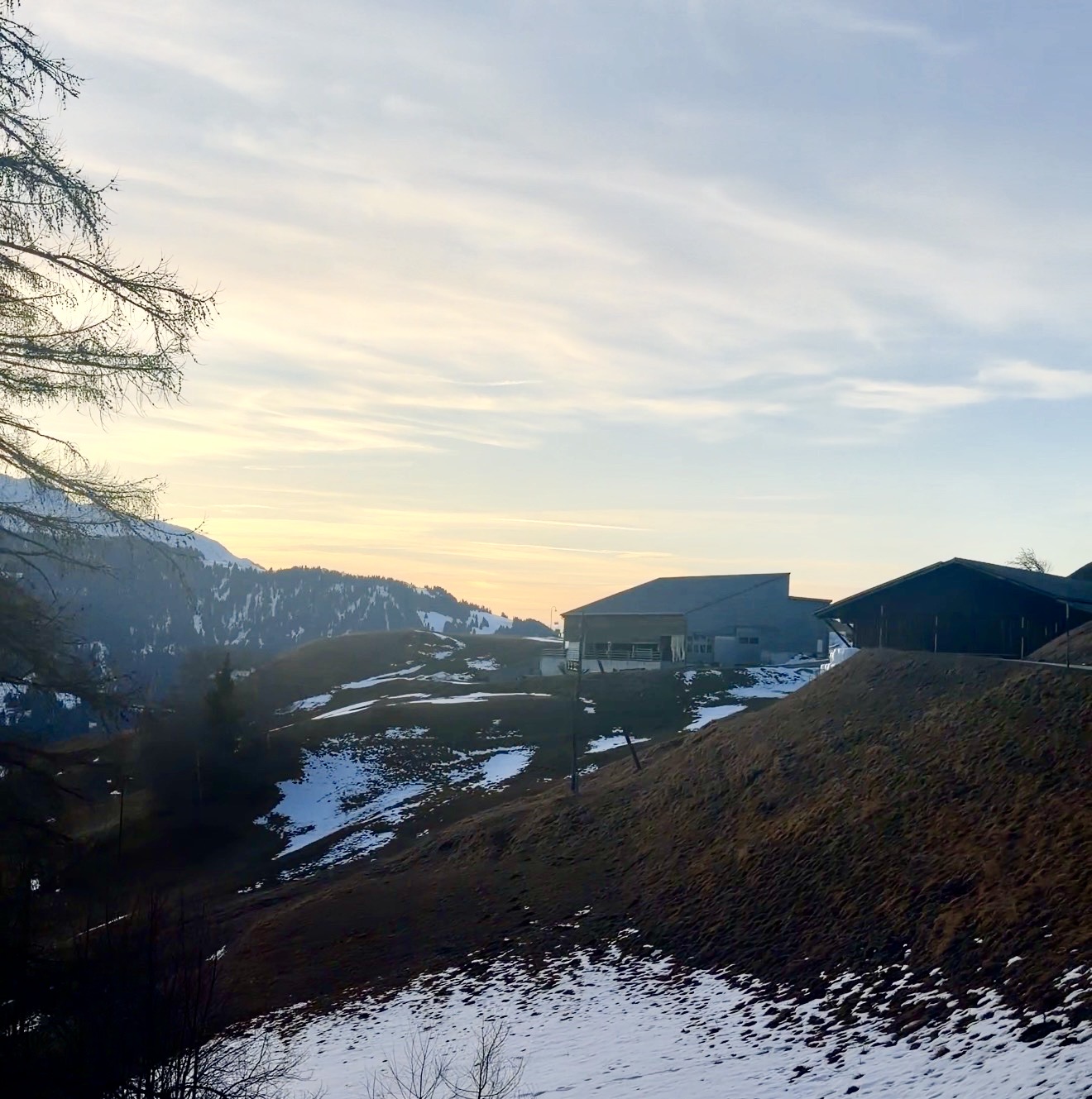
January has been exhausting, but let’s continue to unpack this series. January felt like I was on top of the mountain, the feeling of being as high up in my ventures as I could be, with life feeling good, easy, but also incredibly complex. And while I was literally and figuratively on a mountain in Davos, Switzerland, I did manage to find an escape for a day.
Tucked away in a cabin in the Swiss Alps, I got to sit and really connect with what it means to be at the top of a mountain and to be alone with your thoughts. And what it means when you eventually have to come back down.
I had a conversation with my girlfriend (which, clearly, seems to be a theme) about how there are seasons in your life when you are perpetually climbing. And what you need in those instances, in those moments, is someone who understands the climb, someone who encourages you as you climb.
Imagine trying to climb a mountain when we already know it’s going to be hard. The falling is inevitable. The complaining is part of the process. There are moments when you genuinely can’t do it, when your legs shake, when the path disappears, when you need to stop and catch your breath. And in those moments, the people in your life who truly see you would never tell you the load is too heavy. They wouldn’t ask you to put it down or question why you’re carrying it. Because they understand that your mission in life is greater than the discomfort of the moment.
The people who get it know that being in your purpose means the weight isn’t negotiable. It’s not about whether the climb is hard; it will be hard. It’s about whether the people around you understand the magnitude of what you’re impacting, what you’re building, what you’re called to do. They don’t mistake your exhaustion for weakness. They don’t confuse your need for rest with giving up. They see the mountain for what it is: steep, demanding, worth it. And they remind you that you’re built for this, even when you forget.
Everyone wants a Rolls-Royce but doesn’t know how to maintain it. They want the prestige, the status, the shine, but the upkeep, the patience, the care required? That’s where people fall short. Relationships with people operating at high altitudes require the same level of intentionality. You don’t get to admire the view without understanding what it takes to preserve it. You don’t get to celebrate someone’s peak without being willing to meet them in the valley.
When I was in the cabin, I remember wanting to go down the already paved road to the bottom. But I was encouraged by a friend who said, “This way is quicker. It might still be a little difficult, but I’ve got you. And I’ll be here waiting.”
And as they waited at the bottom of this mountain, and I shakily walked down the grass with mud and uncertainty, trying to balance my knees as if I were a snowboarder, I realized in that moment that as you descend, the thing you need most is reassurance. Reassurance from the people waiting for you. When you’re climbing up, you need encouragement; you need the push to keep going. But coming down requires something different. It requires people who remind you that rest isn’t failure, that taking the quickest path to solid ground isn’t weakness.
Coming down isn’t easy either. But at least you have people encouraging you to descend with ease, letting you know that once you land, it becomes easier here. The paved path may seem like the way, but truly, sometimes you just need to find the quickest way down because the world has become so heavy and hard. And the people who love you understand that sometimes, the fastest route to solid ground is the one that gets you there WHOLE.
And in that moment, as I was descending, I finally realized what all of this was for. All of the highs in life show you your potential. They show that building something great often requires a certain level of discomfort. But building something greater requires you to take breaks so you get to see the work of your hands.
So I encourage those who are currently on this climb, the Black women in corporate America, the 600,000 laid off, those who are trying to navigate what’s next, I encourage you to remember that you’ve climbed before. You know the terrain. You know your capacity. It was a difficult climb to get to where you’ve been, so you know how to do it. But don’t rush. Don’t rush through this descent.
Right now, you may sometimes need to just sit. Sit in the discomfort. Give your brain and body time to reconnect. The disconnect has been around for so long that the version you are living in now feels normal, but it’s not.
More will come. Better will come.
Last week, I found myself at the Grammys, not climbing, not working (ish), just breathing. Surrounded by friends, business associates, and peers who get it. And for the first time in a while, I felt the ease I’d been writing about. The valley isn’t theoretical. It’s tangible. It’s the moments where you’re not “on,” where you can simply exist among people who see you beyond the work, beyond the panels, beyond the noise. That night reminded me that this is what coming down is for. Not to disappear, but to remember what it feels like to just be.
Ensure you have a support system that can hold you and see you. I’ve really enjoyed my friends this season, who keep saying, “We see you, we know you, we hear you.” And they don’t take my thoughts as complaints. They don’t tell me I’m moaning. They understand that to be greater requires a level of breaking down your thoughts and the battle within.
But I say all this to say: I keep thinking about how high you climb, and how quickly the crash sometimes comes. But I’m trying to see it a little bit differently now. The higher that I climb, the more I know what my capacity is, the more I know what I can do, the more uncomfortable I am. Sometimes coming back down is exactly what you need, as long as the people, the person, the business is waiting with their hand held open, reminding you that you’ve got this and they’ve got you.
And that’s what the valley is - not failure, not falling, but the intentional space between climbs where you remember who you are. The valley isn’t where you fail. It’s where you land. It’s where the people who matter most remind you that you are more than the climb, more than the peak, more than what you’ve built. It’s where you remember how to breathe.
“I see you.”
Outside of the corporate noise, the panels, the write-ups, the expectations, they see you for just who you are: someone claiming a moment in the valley.